• Please take a moment and update your account profile. If you have an updated account profile with basic information on why you are on Air Warriors it will help other people respond to your posts. How do you update your profile you ask?

    Go here:

    Edit Account Details and Profile

Navy Dedicated SAR Squadrons

Then again, delivering a raft isn't effecting a rescue. We've been very lucky since Vietnam in terms of the kinds of CSAR environment we've faced, and a relatively small number of people needing rescue. MCO with China would probably mean lots of downed personnel with very little support, or just fending for themselves. I hope our brightest minds are working on that, but it is a tough nut to crack, for sure.

Tough enough that I wonder if it’s better to expend our skull-sweat on ways to avoid that kind of conflict (e.g. focusing on other weapon types & domains), rather than expending what seems to be ever-thinner resources on a multi-thousand mile CSAR chain.

I think a war with China, properly executed, just looks different- perhaps less kinetic and less manned- than any prior war. Otherwise we may be expending a lot of hard-to-replace equipment and people for ??? gain.
 
Tough enough that I wonder if it’s better to expend our skull-sweat on ways to avoid that kind of conflict (e.g. focusing on other weapon types & domains), rather than expending what seems to be ever-thinner resources on a multi-thousand mile CSAR chain.

I think a war with China, properly executed, just looks different- perhaps less kinetic and less manned- than any prior war. Otherwise we may be expending a lot of hard-to-replace equipment and people for ??? gain.
I think an actual conflict over Taiwan is very unlikely, even though that’s what we’re directing our efforts at.
 
I think this was posted before, but I’ll add it again. Interesting to note that the author mentions the US-2. At the very least competent people are thinking about this.

 
The ranges in the Pacific are really going to challenge traditional rotary and even tilt-rotor assets. Likewise, I doubt if we will have the assets available to assemble a full shooter/refuel/EW package for every aircraft that goes down.

I still hold to my opinion it will have to be some type of rescue drone and the downed aircrew will have to climb aboard themselves.
Some scale model wing in ground effect testing:

 
Interesting design from China:


As for search and rescue, it might be safer to go down at sea than on land, considering the increasing preponderance of small drones that are reshaping the modern battlefield. Not sure how realistic helicopter medevac will be in the future.
 
Interesting design from China:


As for search and rescue, it might be safer to go down at sea than on land, considering the increasing preponderance of small drones that are reshaping the modern battlefield. Not sure how realistic helicopter medevac will be in the future.

We just did it in Iran, albeit in a messy way. People are extrapolating a lot from the static Ukrainian front and its massing of small, fiber optic controlled FPV drones. That doesn't scale to many situations or areas. I'm not saying we should ignore that, in fact we need better counter-UAS technology ASAP, but CSAR has faced a ton of threats and yet we keep risking a lot, successfully, to saved our downed aviators.
 
Interesting design from China:


As for search and rescue, it might be safer to go down at sea than on land, considering the increasing preponderance of small drones that are reshaping the modern battlefield. Not sure how realistic helicopter medevac will be in the future.
That was the case in the Solomon’s during WWII. If you went down over land your chances of survival dropped substantially. Ditching at sea improved your odds a little, but rescue operations early in the Pacific were sketchy at best.
 
We just did it in Iran, albeit in a messy way. People are extrapolating a lot from the static Ukrainian front and its massing of small, fiber optic controlled FPV drones. That doesn't scale to many situations or areas. I'm not saying we should ignore that, in fact we need better counter-UAS technology ASAP, but CSAR has faced a ton of threats and yet we keep risking a lot, successfully, to saved our downed aviators.
Unfortunately, there seems to be more instances than just the Russia-Ukraine front. There was a well publicized attack on a Colombian police Blackhawk awhile back. As you said, some places the drones might not scale, other places are going to become hairy (unless you want to surf).

Not sure what the answer will be, maybe some type of quadcopter large enough to fly a wounded personnel back?
 
Interesting design from China:


As for search and rescue, it might be safer to go down at sea than on land, considering the increasing preponderance of small drones that are reshaping the modern battlefield. Not sure how realistic helicopter medevac will be in the future.

I think it's more nuanced than one potentially replacing the other. War evolves, and the role of rotary-wing aircraft will evolve with it. There will always be a need for vertical lift, but it's fair to expect high-speed platforms such as tiltrotors to take over more medevac, CSAR, special operations, and rapid assault missions. But the Ukraine war doesn't really show that conventional helicopters are obsolete. It's more that conventional rotary-wing aircraft struggle to perform those roles in dense, contested airspace. Russia ran into some frankly embarrassing and costly issues, especially with rapid assault, but it still uses Mi-8s for SAR missions regularly, and Mi-8s continue to carry a significant load in its logistics chain.

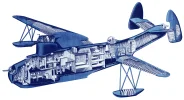
I think as the Navy continues to focus its efforts on a potential future conflict with China, it will become increasingly interested in looking at seaplanes as an alternative to rotary-wing aircraft and runway-dependent fixed-wing aircraft for SAR in the Pacific. The governing concern with SAR in the region wouldn't be tactical drones; it would be the range and staging problem. Rotary-wing aircraft require a forward staging point inside the A2/AD threat envelope. A conventional fixed-wing aircraft would need a runway or nearby airfield, which may be difficult to maintain because of that same area-denial problem. A seaplane would not completely negate any of the risks. China could still lob an IRBM at Guam, for example, but it mitigates the risk of putting a high-value platform such as a DDG or some type of Marine amphib within the densest parts of the envelope. No point in sending out a helicopter to rescue somebody if the ship it launched from is now also in need of rescue operations, or a conventional plane to rescue pilots who crashed in the middle of the ocean without anywhere to land. Because of this, there's some renewed interest in amphibious platforms. The 2026 NDAA included some provisions to at least begin preliminary programs involving commercial planes, there have been attemps to create an amphibious C-130J Model, and some of our allies still operate seaplanes. Not exactly reinventing the wheel at NAVAIR either, the Navy has operated seaplanes for SAR before with the PBY Catalina (scene from a Japanese movie depicting one such rescue) and HU-16.

WIG seaplanes like the Bohai in the article are a separate issue. They are primarily maritime logistics aircraft, and they are big, although the Bohai seems to be a departure from this role with the addition of weapon hardpoints. The better comparison is not an MH-60 replacement, but something closer to a maritime C-17-style logistics platform. DARPA's original Liberty Lifter concept envisioned a plane with a 200+-foot wingspan and a payload around 180,000 lb. The benefit of WIG seaplanes vs. regular seaplanes is payload and range efficiency. If the goal is just maritime SAR, a conventional seaplane like the Japanese US-2 is a better and more likely answer, or an American alternative like the amphibious MC-130J concept if they ever find some money between the couch cushions at the Pentagon to fund it. I don't think we'll ever see a WIG in the Navy or the Air Force's inventory. The Chinese exploration of WIGs is likely just a continuation of what is seemingly an aerospace renaissance within the Chinese defense industry, alongside some influence from Soviet exploration of the concept.

 
Last edited:
The Liberty Lifter program was to a large extent a materials science program, with the challenge being to figure out how to make the plane out of a sea-friendly aluminum alloy. It was a ship designed to fly, understanding most of its life would be on the water. Be great for the tech to make it to a real airplane.

Sign me up for live-aboard seaplane duty. MBM Mariner.
1779800749523.png
 
Unfortunately, there seems to be more instances than just the Russia-Ukraine front. There was a well publicized attack on a Colombian police Blackhawk awhile back. As you said, some places the drones might not scale, other places are going to become hairy (unless you want to surf).

They are still severely limited by range and can usually be used only on static or near-static targets. They are certainly something to be aware of but in the grand scheme of things it is relatively lower on the scale when it comes to threats.
 
Unfortunately, there seems to be more instances than just the Russia-Ukraine front. There was a well publicized attack on a Colombian police Blackhawk awhile back. As you said, some places the drones might not scale, other places are going to become hairy (unless you want to surf).

Not sure what the answer will be, maybe some type of quadcopter large enough to fly a wounded personnel back?

So you're conflating two things I'd argue. The first is the threat from one off FPV drones on a helicopter operating in a somewhat known target area. In addition to what you said, we've seen instances of Israeli Blackhawks being attacked by FPV as well. High value targets of opportunity in a funneled threat area. This is something we need more modern ASE gear to combat IMO. Probably something along the lines of Trophy APS but for rotary wing. Even then, when sitting in an LZ, a top down attack would be difficult to defend against. In these scenarios, the examples we have are almost always daytime. US assets almost always operate at night unless forced to, in which case we're talking hopefully a dynamic environment where the enemy may not be massed.

The second, the Ukraine frontline example, that's very unique and a product of Ukrainian's pre-war weaknesses (air power, long range strike, maneuver elements, naval power projection, amphibious capability, etc) and Russian blunders/weaknesses. As much as NATO and other forces tried to modernize them pre-2014 and in the 2014-2022 timeframe, they still existed on a Soviet model of Artillery + Mechanized elements, with enablers. Once the front became relatively static in late 2023, neither side could mass enough force to overcome the static defenses that had been built up. We've been through multiple evolutions of strike warfare, generations and massing of short range FPVs, and OWA-UAS used at scale. The momentum Ukraine has built in spring 2026 has been a byproduct of massing of drones combined with (finally) SpaceX blocking Russian access to starlink to cause C2 havoc. Ukraine is fighting the righteous battle and I'm frustrated we didn't support them more forcefully, just as I'm frustrated we are limiting support now.

Could the US be forced into something like Ukraine? Probably not? We just don't fight that way. Probably why you don't see DDGs steaming into the SoH killbox daily.
 
Back
Top