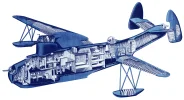
Interesting design from China:
New details add weight to the idea that the “Bohai Sea Monster” has a kinetic role to play, although the general concept could be supersized for other missions. New details add weight to the idea that the “Bohai Sea Monster” may be a subscale demonstrator for a much larger military design.

www.twz.com
As for search and rescue, it might be safer to go down at sea than on land, considering the increasing preponderance of small drones that are reshaping the modern battlefield. Not sure how realistic helicopter medevac will be in the future.
I think it's more nuanced than one potentially replacing the other. War evolves, and the role of rotary-wing aircraft will evolve with it. There will always be a need for vertical lift, but it's fair to expect high-speed platforms such as tiltrotors to take over more medevac, CSAR, special operations, and rapid assault missions. But the Ukraine war doesn't really show that conventional helicopters are obsolete. It's more that conventional rotary-wing aircraft struggle to perform those roles in dense, contested airspace. Russia ran into some frankly embarrassing and costly issues, especially with rapid assault, but it still uses Mi-8s for SAR missions regularly, and Mi-8s continue to carry a significant load in its logistics chain.
I think as the Navy continues to focus its efforts on a potential future conflict with China, it will become increasingly interested in looking at seaplanes as an alternative to rotary-wing aircraft and runway-dependent fixed-wing aircraft for SAR in the Pacific. The governing concern with SAR in the region wouldn't be tactical drones; it would be the range and staging problem. Rotary-wing aircraft require a forward staging point inside the A2/AD threat envelope. A conventional fixed-wing aircraft would need a runway or nearby airfield, which may be difficult to maintain because of that same area-denial problem. A seaplane would not completely negate any of the risks. China could still lob an IRBM at Guam, for example, but it mitigates the risk of putting a high-value platform such as a DDG or some type of Marine amphib within the densest parts of the envelope. No point in sending out a helicopter to rescue somebody if the ship it launched from is now also in need of rescue operations, or a conventional plane to rescue pilots who crashed in the middle of the ocean without anywhere to land. Because of this, there's some renewed interest in amphibious platforms. The 2026 NDAA included some provisions to at least begin preliminary programs involving commercial planes, there have been attemps to create an amphibious C-130J Model, and some of our allies still operate seaplanes. Not exactly reinventing the wheel at NAVAIR either, the Navy has operated seaplanes for SAR before with the PBY Catalina (
scene from a Japanese movie depicting one such rescue) and HU-16.
WIG seaplanes like the Bohai in the article are a separate issue. They are primarily maritime logistics aircraft, and they are big, although the Bohai seems to be a departure from this role with the addition of weapon hardpoints. The better comparison is not an MH-60 replacement, but something closer to a maritime C-17-style logistics platform. DARPA's original Liberty Lifter concept envisioned a plane with a 200+-foot wingspan and a payload around 180,000 lb. The benefit of WIG seaplanes vs. regular seaplanes is payload and range efficiency. If the goal is just maritime SAR, a conventional seaplane like the Japanese US-2 is a better and more likely answer, or an American alternative like the amphibious MC-130J concept if they ever find some money between the couch cushions at the Pentagon to fund it. I don't think we'll ever see a WIG in the Navy or the Air Force's inventory. The Chinese exploration of WIGs is likely just a continuation of what is seemingly an aerospace renaissance within the Chinese defense industry, alongside some influence from Soviet exploration of the concept.