A recap of current Chinese air-to-air missiles:
The AAMs are designated PL (for
pili = Thunderbolt)
The standard PL-8 short-range IR-homing missile was a license-produced copy of the Israeli Python-3 and became operational in the PLA in 1988; it is still in widespread use, although the Chinese have upgraded the missiles with domestically produced components.
The PL-8 has been succeeded by an all-Chinese PL-10 which entered service in 2015. It features thrust vectoring for improved agility and is assessed as superior in performance to the U.S. AIM-9X. A version with an active radar seeker was observed in 2022, but its status is unknown. As with most PRC missiles, it has been sold to Pakistan.
The standard radar-guided BVR missile is the PL-12, which is considered comparable to the AIM-120B/C AMRAAM. IOC was 2005. Early missiles included some Russian components. The guidance system includes data-linked mid-course guidance and terminal active radar homing. It may also have a passive homing mode for use against jamming or AEW aircraft. The max range is estimated to be about 100 km. Export versions provided to Pakistan and Myanmar have less range.
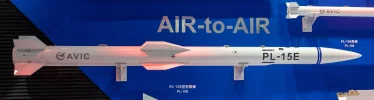
The PL-12's replacement entered service within the past decade. The PL-15's launch weight is about 450-500 pounds. It reaches speeds of Mach 5 and has a range of 200 km or more. It features cropped control fins to facilitate internal carriage by stealthy fighters. As with previous missiles, China has produced an export model -- the PL-15E -- for export to Pakistan. The Pakistani Air Force has used the PL-15E in combat with Indian Air Force aircraft with some success. Although the PL-15E is limited to a max range of about 145 km, Indian sources claim shootdowns at ranges of 200 km and also claim to have recovered PL-15Es that landed "intact".
There are also surface-to-air and anti-radar homing variants of the PL-15 under development.
The PL-16 is a more compact version of the PL-15 which allows more missiles to be carried internally by the J-20 fighter. Despite the more compact dimensions, the performance is assessed as equivalent.
Finally, a large, long-range missile -- the PL-17 is under development. The PL-17 is analogous to the USN's AIM-174B; very large with 400km range and designed to attack AEW or tanker aircraft. It can only be carried externally.