• Please take a moment and update your account profile. If you have an updated account profile with basic information on why you are on Air Warriors it will help other people respond to your posts. How do you update your profile you ask?

    Go here:

    Edit Account Details and Profile

Chinese Aviation Developments

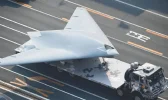
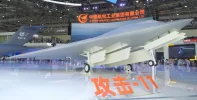
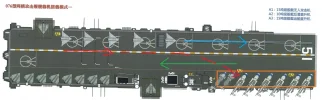
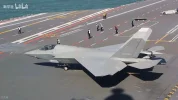
Chinese GJ-11 attack UAV. Single engine with weapons bays on either side of engine. 40 feet long and 47.3-foot span. It is probably that these attack aircraft will be embarked aboard the new 50,000-ton LHD with a single EMALS catapult. The first LHD is doing sea trials now (but without aircraft, I believe.) Here's a speculative aircraft layout with 15 attack UAVs, 2 ASW helos and 6 troop transport helos.

GJ-11-Sharp-Sword-Drone.jpgGJ-11 at 2021 air show.jpgType 076 LHD deckload.jpg
 
PLA Navy carrier-based Shenyang J-15T Flanker heavy fighters have now been observed carrying YJ-15 ramjet-powered antiship missiles (max two per aircraft, I think). While open-source info on this missile is hard to come by, Japanese sources estimate that the YJ-15 has a speed of Mach 5+ and a range of at least 1,200 km and possibly as much as 1,800 km. Potentially a very potent weapon!

YJ-15 antiship missile.jpg
 
To state the obvious, it seems clear that the Chinese J-35 carrier strike fighter (and its cousin the J-35A PLAAF strike fighter) borrow heavily from the U.S. F-35 design. While the prototypes flew initially with Russian power, the production models feature Guizhou WS-19 afterburning turbofans that are estimated to produce 25-26,000 pounds of thrust in A/B. The internal fuel is estimated at about 15,900 pounds and the max takeoff weight at 66,000 pounds plus. The internal bays accommodate six air-to-air missiles and there are six hardpoints on the wings.

The J-35A air force version has less wing area and a single nose wheel; I'd guess it also deletes wing folding.
J-35 on deck of CV-18.jpgJ-35 underside.jpgPLA Navy aviator wings.jpg
Does any of this sound familiar? :D
 
To state the obvious, it seems clear that the Chinese J-35 carrier strike fighter (and its cousin the J-35A PLAAF strike fighter) borrow heavily from the U.S. F-35 design. While the prototypes flew initially with Russian power, the production models feature Guizhou WS-19 afterburning turbofans that are estimated to produce 25-26,000 pounds of thrust in A/B. The internal fuel is estimated at about 15,900 pounds and the max takeoff weight at 66,000 pounds plus. The internal bays accommodate six air-to-air missiles and there are six hardpoints on the wings.

The J-35A air force version has less wing area and a single nose wheel; I'd guess it also deletes wing folding.
View attachment 44792View attachment 44793View attachment 44794
Does any of this sound familiar? :D
The Chinese have been swinging a scythe through their weapon design teams. They are genuinely upset that their systems sold to Venezuela and Iran have failed so badly and their jet programs are meeting the “look” but wildly under-performing. This is the biggest firings are noted here.

 
The Chinese have been swinging a scythe through their weapon design teams. They are genuinely upset that their systems sold to Venezuela and Iran have failed so badly and their jet programs are meeting the “look” but wildly under-performing. This is the biggest firings are noted here.


Huh. Who knew systems integration was so hard?

;)
 
The JL-1 air-launched ballistic missile (NATO CH-AS-X-13) became operational in 2025. It appears to be related to the DF-21 "carrier killer" ballistic missile but adapted for launch from the Xi'an H-6N bomber. The open-source speculation is that it is both nuclear and conventional capable and has an effective range of 3,000 to 5,000 km. The warhead is maneuverable and the missile can alternatively carry a hypersonic glide vehicle.

The H-6 is of ancient design (see Tupolev Tu-16), but the PLAAF has updated it. It is now apparently now out of production and about 200 are in service.

The next-generation bomber will be a stealth flying wing -- also capable of employing the JL-1.


H-6N with JL-1.jpg
 
hypersonic glide vehicle.
Is this even possible? Will one of you engineer or test pilot dudes explain to me how you can get to hypersonic speeds gliding through the atmosphere?
 
A recap of current Chinese air-to-air missiles:

The AAMs are designated PL (for pili = Thunderbolt)

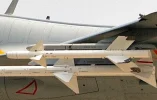
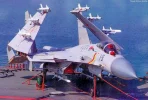
The standard PL-8 short-range IR-homing missile was a license-produced copy of the Israeli Python-3 and became operational in the PLA in 1988; it is still in widespread use, although the Chinese have upgraded the missiles with domestically produced components.

The PL-8 has been succeeded by an all-Chinese PL-10 which entered service in 2015. It features thrust vectoring for improved agility and is assessed as superior in performance to the U.S. AIM-9X. A version with an active radar seeker was observed in 2022, but its status is unknown. As with most PRC missiles, it has been sold to Pakistan.

The standard radar-guided BVR missile is the PL-12, which is considered comparable to the AIM-120B/C AMRAAM. IOC was 2005. Early missiles included some Russian components. The guidance system includes data-linked mid-course guidance and terminal active radar homing. It may also have a passive homing mode for use against jamming or AEW aircraft. The max range is estimated to be about 100 km. Export versions provided to Pakistan and Myanmar have less range.

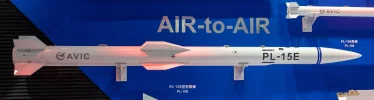
The PL-12's replacement entered service within the past decade. The PL-15's launch weight is about 450-500 pounds. It reaches speeds of Mach 5 and has a range of 200 km or more. It features cropped control fins to facilitate internal carriage by stealthy fighters. As with previous missiles, China has produced an export model -- the PL-15E -- for export to Pakistan. The Pakistani Air Force has used the PL-15E in combat with Indian Air Force aircraft with some success. Although the PL-15E is limited to a max range of about 145 km, Indian sources claim shootdowns at ranges of 200 km and also claim to have recovered PL-15Es that landed "intact".

There are also surface-to-air and anti-radar homing variants of the PL-15 under development.

The PL-16 is a more compact version of the PL-15 which allows more missiles to be carried internally by the J-20 fighter. Despite the more compact dimensions, the performance is assessed as equivalent.

Finally, a large, long-range missile -- the PL-17 is under development. The PL-17 is analogous to the USN's AIM-174B; very large with 400km range and designed to attack AEW or tanker aircraft. It can only be carried externally.
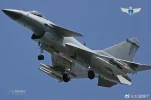
PL-15E AAM.jpgJ-15 with 4 PL-12 and 4 PL-8B.jpgJ-10C with PL-15 and PL-10 AAMs.jpgPL-17-mock-up.jpg
PL-8_missile.jpg
 
Back
Top