
-
Please take a moment and update your account profile. If you have an updated account profile with basic information on why you are on Air Warriors it will help other people respond to your posts. How do you update your profile you ask?
Go here:
Edit Account Details and Profile
You are using an out of date browser. It may not display this or other websites correctly.
You should upgrade or use an alternative browser.
You should upgrade or use an alternative browser.
The SHOW: Airlines still a "good gig"??
- Thread starter A4sForever
- Start date


“Tell me about a time you had a conflict in the flight deck.”
The way I’m reading this, the attacking FO was subdued but the CA was incapacitated, and it was two commuting/deadheading pilots who actually took control and landed the airplane safely. Holy hell this could have gone so much worse than it did.
The way I’m reading this, the attacking FO was subdued but the CA was incapacitated, and it was two commuting/deadheading pilots who actually took control and landed the airplane safely. Holy hell this could have gone so much worse than it did.

That takes CRM to a whole new level.Wow, whatever this ends up being (terrorism, workplace violence, etc), kudos to that pilot for at least getting the plane on the ground.

GroundPounder
Well-Known Member
It's happend here, thankfully it's still a rare occuerance. I'd imagine that the danger level is as low as it can possibly be made in the US. Other parts of the world, not so much.

And sometimes, it's not even the pilots who decide to deviate from the plan.
And sometimes, it's not even the pilots who decide to deviate from the plan.

MeowProbably a debate over VFR cruising altitudes that got out of hand.

East is Odd and you're fucking nuts?Probably a debate over VFR cruising altitudes that got out of hand.

It looks like one of the pilots of a FlyDubai 737 stabbed the other one on a flight from Dubai to Israel, passengers intervened and the plane landed in Saudi Arabia. The flight was violent enough to rip off much of the rudder.
View attachment 46297
View attachment 46296
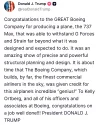

He’s just sniffing rear ends in a gambit to get the FA-XX named the “Golden Trump.” Pete, however isn’t happy, he wants it called the FA-XX “Lethal Jet.”
How quickly we forget.
The Boeing 737 MAX has faced major safety, software, and manufacturing problems, led by deadly crashes and ongoing regulatory delays.
The Fatal Crashes and MCAS
- The root design change: Boeing used larger, more efficient engines placed higher and further forward on the wings. This changed how the plane handled and caused the nose to pitch upward during certain high-power climbs.
- The MCAS flaw: To fix this tendency without requiring expensive pilot retraining, Boeing added an automated software system called the Maneuvering Characteristics Augmentation System (MCAS).
- The failures: MCAS pushed the aircraft's nose down based on faulty data from a single angle-of-attack sensor. This caused two fatal crashes—Lion Air Flight 610 and Ethiopian Airlines Flight 302
—which killed 346 people and resulted in a worldwide grounding of the jet for nearly two years.
Wikipedia +1
Recent Software and Structural Issues:
- Latest software glitch: The Federal Aviation Administration (FAA) delayed the certification of the 737 MAX 10 due to a newly discovered software bug. This glitch can cause pilots to lose automated vertical landing guidance during a missed approach (go-around), forcing them to use manual or secondary pitch control.
CNBC +3
- Fuselage and door plug incidents: In early 2024, an Alaska Airlines MAX 9 suffered an uncontrolled decompression after an exit door plug blew out mid-flight, sparking criminal investigations and intense scrutiny over factory quality control.
CNBC +1
- Inspection orders: The FAA ordered mandatory inspections of hundreds of 737 MAX planes to check for structural cracks near forward service doors.
CBS News +1
The irony was not lost on me!!!!How quickly we forget.
United is crushing it - I think Scott Kirby is a brilliant leader and manager.
Delta Airlines is setting itself up forruin market challenges with CEO Ed Bastian blamed Elon’s character as the reason they didn’t choose Starlink. Hopefully you guys who work for Delta are talking this up.
Delta Airlines is setting itself up for
Last edited:
I fly for a Delta Connection carrier and fly on Delta mainline to and from my reserve job. I don’t know what exactly is up with the trons (there are 2 different setups my company’s jets can have), but I can confirm our in-flight Wi-Fi experience is just objectively subpar at this point in time. We NEED Starlink or something analogous.

United is crushing it - I think Scott Kirby is a brilliant leader and manager.
Delta Airlines is setting itself up for ruin with CEO Ed Bastian blamed Elon’s character as the reason they didn’t choose Starlink. Hopefully you guys who work for Delta are talking this up.
The wifi needs to be upgraded but the entire corporation is not going to be in ruins over wifi.
Besides the fact that there will still always be people flying on the airline, diverse revenue streams from credit cards, MRO, and (these days) the refinery means everything is fine.
Wifi will not bankrupt a company. It won't even make a huge dent. However, it will sting a little bit and the problem needs to be fixed.