AircraftGeek513
Well-Known Member
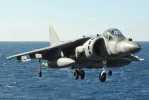
June 3rd of this year is the scheduled AV-8B Sundown Ceremony



I'll use this opportunity to highlight the fact that STOVL aircraft are, and have always been, a complete waste of resources. Amphibs should carry amphibious things that go ashore, and supporting fixed wing aircraft should be on proper aircraft carriers.
I assume it as hovering over them...Did a Harrier guy shit on your pancakes?

I agree when they are operated from what are essentially capital ships that happen to be amphibs. When the day comes that they are flown from non-traditional platforms too ubiquitous to completely track, then they could hit a sweet spot.waste

I agree when they are operated from what are essentially capital ships that happen to be amphibs. When the day comes that they are flown from non-traditional platforms too ubiquitous to completely track, then they could hit a sweet spot.

These are great points and educating!The Harrier is a unique airplane with a storied history. However...
Using STOVL jets that way is highly unlikely with our political and military structure (even as twisted as it's been by the current administration).
Under current doctrine, I largely agree with @Brett327. The cost and design compromises to equip a tactical jet with STOVL capability make it a less capable combat platform than a similar airplane with conventional runway or CATOBAR capability. In the case of F-35B, perceived need for a hovering jet cost the whole program time and money to develop a variant that now costs more to get airborne with less.
If your country happens to have aircraft carriers and runways, why bother adding STOVL capes to a design?
These are great points and educating!
I always presumed doctrine was to get the STOVL jets off the amphib deck to an inland expeditionary operating base - highway or a "long enough" piece of hard stand and support troops at the forward edge of the battle area and quick turn from your hasty operating base/FARP, etc.
These are great points and educating!
I always presumed doctrine was to get the STOVL jets off the amphib deck to an inland expeditionary operating base - highway or a "long enough" piece of hard stand and support troops at the forward edge of the battle area and quick turn from your hasty operating base/FARP, etc.
If we’re storming the beaches of Normandy, Greenland, or wherever, why not use shore and carrier-based aircraft that can return to where they have regular resupply of fuel, ammo, parts, and relief pilots? That is way less shit for your MEU to haul ashore (or more room for other MEU fighting/logistics equipment), and we’ve demonstrated our ability to conduct CAS and DAS hundreds of miles from friendly basing without operating expensive and finicky jets from austere locations vulnerable to enemy fire.
There is no way the Marines are going to give up any level of command and control to the Navy or Air Force when it comes to air support.
And yet, in practice, they do. Who were most of the people supporting USMC in AFG? The Navy didn’t give Marines the LHDs, either.
So why be so parochial about air support?
A couple reasons. The vast majority of Marine air support doesn’t involve dropping bombs on a target. Secondly, the ability for us to “own” airspace relies on having an ability to defend it. Largely provided by Marine TACAIR. In practice, that ownership means when aircraft come to work into our airspace, we have the biggest (If not all) say in how it is employed. That has probably been transparent to you. It also gives us a seat at the big air planning table. You guys are focusing on the ship as the biggest issue, but it extends way further into how we operate as a multi-domain task force. We can debate STOVL vs non-STOVL all day long - but that was a problem created by budget crunchers years ago.
I watched a ship captain pull a boat off station to do a crossing the line ceremony in the middle of a named op. In doing so, It pushed our alert lines out of range. Color me skeptical about Navy commanders and their priorities. Risk at sea does not equal risk ashore.
I see where you’re coming from but that’s not the entire story. We have extensive SOPs, planning process, and training standards that we practice that most services are unaccustomed. We are often questioned or denigrated because of it. Most commanders will never turn down extra support, but will always prefer their own guys due to that training. We also regularly experience the Army or Air Force coming in and trying to tell us how to do business. Both on the ground and in the air, so the reflexive “thanks, but no thanks” attitude is where that is generated. My personal experience was A-10 pilots trying to take the stack from my hands as a FAC, with none of them realizing myself and 2 other guys controlling air were pilots (AH-1, F/A-18, CH-53). That debate did not go well for them when the BN CO kicked them out of our airspace. A Marine Hornet or Harrier section would’ve never even asked. I like to believe that was a one off scenario, but I’ve heard of several other stories.This seems to boil down to Marines not wanting to play with non-Marines. I have a lot of respect for the Corps, but I saw that attitude play out while I was on AD, even when the mission set was something understood and practiced by other services (e.g. CAS). Saying “It’s a Marine thing. You’ll never understand” (I heard this multiple times) is a poor way to have a conversation about maximizing available resources.

Careful now... you're not allowed to call Navy / USMC operations 'joint' these days... and that's actually written somewhere in a pub whose name I can't remember.Part of why we struggle with joint operations is attitudes like this. It’s a self-perpetuating problem, baked in by history.