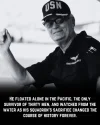
Ensign George H. Gay Jr. spent seventeen hours floating in the Pacific Ocean, surrounded by the bodies of his friends, pretending to be dead so the enemy would not kill him.
That was June 4, 1942. The date would become famous as the turning point of the Pacific War. But for George Gay, it would always be the day he watched twenty-nine men die and could do nothing to save them.
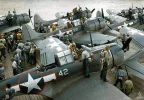
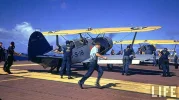
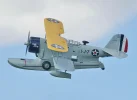
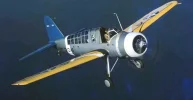
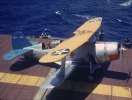
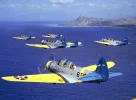
Gay was twenty-five years old when he joined Torpedo Squadron Eight, a unit of Navy aviators based aboard the USS Hornet. They flew the Douglas TBD Devastator, a torpedo bomber that was already obsolete before the war even started. The aircraft was slow—cruising at barely over 100 miles per hour. It was lightly armed, with a single rear-facing machine gun. Its torpedo release system was unreliable. In combat, it was a coffin with wings.
The men of Torpedo Squadron Eight knew this. They joked about it. They complained about it. And when the order came to launch against the Japanese fleet at Midway, they climbed into those planes anyway.
The Battle of Midway was supposed to be an ambush. American intelligence had cracked Japanese naval codes and knew the enemy fleet was coming. The plan was to catch them by surprise and destroy their carriers before they could launch a devastating attack on Midway Island and potentially the Hawaiian Islands beyond.
But plans are fragile things in war.
On the morning of June 4, Torpedo Squadron Eight took off from the Hornet and flew toward the Japanese fleet. There were fifteen aircraft in the formation. Thirty men total—pilots and radiomen/gunners. Their mission was simple in theory: fly low, release torpedoes at the enemy carriers, and cripple the Japanese striking power.
In practice, it was a suicide run.
The Devastators had to fly straight and level to release their torpedoes, which meant they had to get close—very close—to heavily defended warships bristling with anti-aircraft guns. And they had to do it slowly, at low altitude, with no fighter escort to protect them from the swarm of Japanese Zero fighters that would inevitably tear into them.
Lieutenant Commander John Waldron, the squadron leader, understood what they were facing. Before takeoff, he told his men that if only one plane survived to make an attack, the mission would be worth it. He did not say it to inspire them. He said it because it was true.
They flew for hours, searching for the Japanese fleet across an empty ocean. When they finally found it, there was no time for hesitation. Waldron led the squadron into the attack.
The Zeros came immediately.
Japanese fighter pilots dove on the slow-moving torpedo bombers like hawks on field mice. The Devastators had no chance to maneuver, no speed to escape, no altitude to trade for evasion. One by one, they were shot down. Some exploded in midair. Others crashed into the ocean trailing smoke and fire. The rear gunners fired back until their guns went silent or their planes disintegrated around them.
George Gay pressed his attack. His radioman/gunner, Bob Huntington, fired at the Zeros until his gun jammed. Gay kept flying, lining up his torpedo run on the Japanese carrier Kaga. He released his torpedo—it missed. Seconds later, his plane was hit. Bullets tore through the fuselage. The engine caught fire. The controls went dead.
Gay's last memory before impact was seeing Bob Huntington slumped over in the rear cockpit, killed by enemy fire.
The plane hit the water hard. Gay was thrown clear. The aircraft sank within seconds. He surfaced, gasping, bleeding, and alone. The battle was still raging overhead. Zeros circled, strafing anything that moved. Gay inflated a seat cushion to stay afloat and pulled a rubber raft—damaged and mostly deflated—over his head as camouflage.
And then he waited.
From the water, George Gay watched the entire battle unfold. He saw American dive bombers arrive—three squadrons that had been searching separately for the Japanese fleet. He watched them roll into their attack dives, screaming down from high altitude, beyond the reach of the Zeros that had slaughtered the torpedo bombers.
He watched bombs strike the Japanese carriers Akagi, Kaga, and Soryu. He saw massive explosions tear through their flight decks, igniting fuel and munitions. He watched the ships burn and begin to list.
He watched the battle turn.
The sacrifice of Torpedo Squadron Eight had not sunk a single ship. Their torpedoes had missed. Their attack had been obliterated. But they had drawn the Japanese combat air patrol down to the deck, leaving the sky open for the dive bombers to strike unopposed.
Gay floated in the water and understood: his friends had not died for nothing.
But understanding that did not make him feel better. It did not bring them back. It did not stop him from floating among their bodies, from seeing the wreckage of their planes scattered across the ocean, from knowing that he was alive and they were not.
He stayed in the water all day and through the night, hiding when Japanese ships passed nearby, too exhausted and too afraid to move. Finally, on the afternoon of June 5, a Navy PBY Catalina search plane spotted him and pulled him from the ocean. He had been in the water for more than seventeen hours.
When Gay returned to the Hornet, he learned what he already knew: he was the only survivor. Fifteen aircraft had launched. Thirty men had flown into battle. Twenty-nine were dead.
George Gay was the sole survivor of Torpedo Squadron Eight.
The Navy treated him as a hero. They promoted him. They sent him on war bond tours. They asked him to tell his story again and again to inspire the public. And he did, because that was his duty.
But inside, George Gay carried something heavier than medals.
He carried the weight of twenty-nine men who did not come home. He carried the memory of Bob Huntington, who died in the seat behind him. He carried the knowledge that survival was not a reward—it was a responsibility.
After the war, Gay did not try to forget. He spent the rest of his life honoring the men of Torpedo Squadron Eight. He attended reunions, gave interviews, wrote a memoir, and spoke to anyone who would listen about what those men had done. He made sure their names were remembered. He made sure their sacrifice was not reduced to a footnote in history books.
George Gay lived until 1994. He was seventy-seven years old when he died. For fifty-two years after Midway, he carried the story of that day with him, not as a burden, but as a promise.
He did not survive because he was lucky.
He survived because someone had to tell the story.
He survived because twenty-nine men flew into hell knowing they would not come back, and someone needed to make sure the world knew they had been there.
Some men are remembered because they won.
George Gay is remembered because he survived to honor those who did not.
And that, in its own way, is a different kind of courage.