
By the turn of the decade in 1960, the Navy was ready to get going on replacing the Douglas A4D (later A-4) on carrier decks. Nuclear weapons delivery was still the top priority mission and the initial concept considered by the Navy was called VA(X) and was conceptualized as a supersonic attack aircraft. There was even discussion of giving the new attack aircraft a variable geometry wing.
But money was tight -- the Navy was developing new heavy attack (A-5 Vigilante), medium all-weather attack (A-6 Intruder) and fighter (F-4 Phantom) aircraft at the time. Accordingly, fiscal reality soon reared its ugly head and the VA(X) program died quickly, to be replaced by a VA(L) competition for a subsonic light attack aircraft to replace the Douglas A4Ds and piston ADs (later A-1s) that were the standard Navy attack aircraft. A new Secretary of Defense, Robert S. McNamara, imposed a rigorous analytic approach to aircraft procurement -- he wanted detailed analysis for proposed systems and brought with him a large number of young program analysts -- called the "whiz kids" at the time. Any new start had to undergo an unprecedented, detailed analysis across the board of all factors involved in a proposed aircraft.
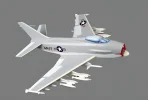
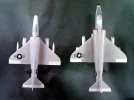
Douglas figured they had the deal locked up -- after all, A-1s and A-4s filled carrier decks. The Navy wanted more range and there was a new turbofan engine that promised to deliver: The Pratt & Whitney TF30. Douglas proposed an "A4D-6" that was an upsized A-4 powered by a TF30 and featured a 36 percent increase in internal fuel. The Douglas had the same five external stores stations as the A-4E (old A4D-5).
The Navy didn't bite -- they wanted a competition. In addition to more range, they also wanted more external stores stations. Of course, there were the usual desired factors of improved avionics, good carrier suitability, low maintenance requirements, etc.
In 1962, the competition started to take shape. Douglas' "A4D-6" was still on offer but now had rivals.
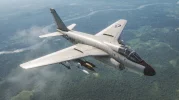
Grumman proposed a single seat version of the A-6 Intruder. It did not use the Navy's preferred turbofan but retained twin J52s. It featured simplified avionics and added twin 20mm cannon for strafing. Grumman knew that spotting factor would be a drawback, as would price, but believed that development cost would be far lower for their entry, which got the Grumman designation of G-128G-12.
Vought had become Ling-Temco-Vought and the LTV entry was an "attack Crusader" based on the F-8. It was considerably shorter and had a slightly larger wing with a different airfoil than the supersonic F-8. It initially featured four underwing stores stations per side -- when the Navy expressed concern about stores separation, LTV reduced the stores stations to three per side. It incorporated the Navy-preferred TF30 engine and Vought stressed commonality with the F-8 that was already in service, although analysis showed only 13 percent airframe commonality.
Finally, North American offered a developed version of the FJ-4B (AF-1E) Fury attack aircraft. The NA-295 proposal featured a radar below the nose air intake for the TF30 engine. The main landing gear retracted forward to provide extra internal fuel capacity in the wings and a pair of extensions in the wings housed the MLG when retracted.
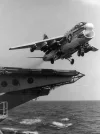
BuWeps had the proposals in hand by 1963. Grumman's Intruder-based entry was the first to go -- too big, too expensive. The Navy considered the Douglas entry to lack the desired range and payload capacity. That left LTV and North American; their entries were considered to be approximately equal in capability, but the LTV proposal was judged to cost less. Accordingly, in early 1964 the development contract was awarded to LTV and thus was born the A-7 SLUF.
But money was tight -- the Navy was developing new heavy attack (A-5 Vigilante), medium all-weather attack (A-6 Intruder) and fighter (F-4 Phantom) aircraft at the time. Accordingly, fiscal reality soon reared its ugly head and the VA(X) program died quickly, to be replaced by a VA(L) competition for a subsonic light attack aircraft to replace the Douglas A4Ds and piston ADs (later A-1s) that were the standard Navy attack aircraft. A new Secretary of Defense, Robert S. McNamara, imposed a rigorous analytic approach to aircraft procurement -- he wanted detailed analysis for proposed systems and brought with him a large number of young program analysts -- called the "whiz kids" at the time. Any new start had to undergo an unprecedented, detailed analysis across the board of all factors involved in a proposed aircraft.
Douglas figured they had the deal locked up -- after all, A-1s and A-4s filled carrier decks. The Navy wanted more range and there was a new turbofan engine that promised to deliver: The Pratt & Whitney TF30. Douglas proposed an "A4D-6" that was an upsized A-4 powered by a TF30 and featured a 36 percent increase in internal fuel. The Douglas had the same five external stores stations as the A-4E (old A4D-5).
The Navy didn't bite -- they wanted a competition. In addition to more range, they also wanted more external stores stations. Of course, there were the usual desired factors of improved avionics, good carrier suitability, low maintenance requirements, etc.
In 1962, the competition started to take shape. Douglas' "A4D-6" was still on offer but now had rivals.
Grumman proposed a single seat version of the A-6 Intruder. It did not use the Navy's preferred turbofan but retained twin J52s. It featured simplified avionics and added twin 20mm cannon for strafing. Grumman knew that spotting factor would be a drawback, as would price, but believed that development cost would be far lower for their entry, which got the Grumman designation of G-128G-12.
Vought had become Ling-Temco-Vought and the LTV entry was an "attack Crusader" based on the F-8. It was considerably shorter and had a slightly larger wing with a different airfoil than the supersonic F-8. It initially featured four underwing stores stations per side -- when the Navy expressed concern about stores separation, LTV reduced the stores stations to three per side. It incorporated the Navy-preferred TF30 engine and Vought stressed commonality with the F-8 that was already in service, although analysis showed only 13 percent airframe commonality.
Finally, North American offered a developed version of the FJ-4B (AF-1E) Fury attack aircraft. The NA-295 proposal featured a radar below the nose air intake for the TF30 engine. The main landing gear retracted forward to provide extra internal fuel capacity in the wings and a pair of extensions in the wings housed the MLG when retracted.
BuWeps had the proposals in hand by 1963. Grumman's Intruder-based entry was the first to go -- too big, too expensive. The Navy considered the Douglas entry to lack the desired range and payload capacity. That left LTV and North American; their entries were considered to be approximately equal in capability, but the LTV proposal was judged to cost less. Accordingly, in early 1964 the development contract was awarded to LTV and thus was born the A-7 SLUF.
Last edited:
