
-
Please take a moment and update your account profile. If you have an updated account profile with basic information on why you are on Air Warriors it will help other people respond to your posts. How do you update your profile you ask?
Go here:
Edit Account Details and Profile
You are using an out of date browser. It may not display this or other websites correctly.
You should upgrade or use an alternative browser.
You should upgrade or use an alternative browser.
Hot new helicopter/rotorcraft news
- Thread starter Randy Daytona
- Start date


And it flies like it. The 206B feels heavy duty by comparison.That bird is tiny!

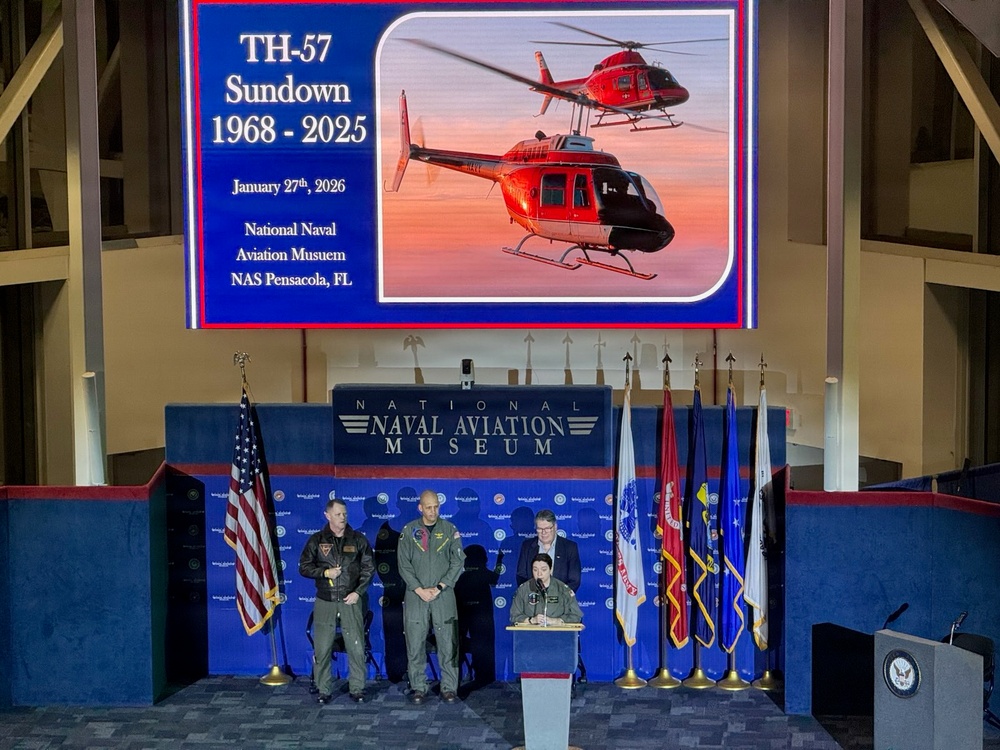
Honoring Legacy: The TH-57 Makes Its Final Landing at the National Naval Aviation Museum
A significant chapter in U.S. Navy aviation history was commemorated as the Bell TH-57 “Sea Ranger” made its final landing at National Naval Aviation Museum in Pensacola, Florida. The landing marked the official retirement of the TH-57, a pivotal training aircraft that has served as the...

At least Navy students switch to the 119 before going to a fleet bird.And it flies like it. The 206B feels heavy duty by comparison.
If Army goes this way, students could go from a Robbie to a Chinook!
Yet somehow they think small help “stick and rudder” should equals safety.

I believe they did the same back in the day from the TH-55, no? (Maybe an intermediate stop in the H-1?)If Army goes this way, students could go from a Robbie to a Chinook!
It depends on the era. During VN they went from a light bird like the TH-55 (or Sioux/Raven) to a medium H-19 and then on the UH-1. During the 70’s and 80’s they went from the TH-55 to the OH-58 and then on but there were periods where they went directly from the TH-55 to their “go to war” helicopter. For a short period of time the army used UH-1’s from start to finish. Most army guys I know consider the brief “all UH-1” training the apex of Rucker training. I will say that even the 300C (civilian version of the TH-55) feels heavier than an R-44 probably because of the rotor system. That said, I’ve never flown an R-66, maybe it feels different than an R-44.I believe they did the same back in the day from the TH-55, no? (Maybe an intermediate stop in the H-1?)

At least Navy students switch to the 119 before going to a fleet bird.
If Army goes this way, students could go from a Robbie to a Chinook!
Yet somehow they think small help “stick and rudder” should equals safety.
From a chat with a now former co-worker of mine who was Navy and now is in the Guard...
When the Army was having a spat of back-to-back mishaps in 2025 or 2024 (I can't remember which), he made the observation that what did the Army do when airmanship and decision making appeared to be an issue? Conduct a stand down and make everyone take a closed book test.
Mission Accomplished.
From a chat with a now former co-worker of mine who was Navy and now is in the Guard...
When the Army was having a spat of back-to-back mishaps in 2025 or 2024 (I can't remember which), he made the observation that what did the Army do when airmanship and decision making appeared to be an issue? Conduct a stand down and make everyone take a closed book test.
Mission Accomplished.
To be fair, safety standdowns are the coin of the realm in aviation when leadership has no idea what to do.
The Army continues to have a high mishap rate and blames it on poor basic airmanship, which they don't think a Lakota can teach, since it has a pretty good stab system. They also think that having too much tail rotor authority is bad, because it allegedly teaches bad power management, and they've had Apache pilots run out of left pedal more than they'd like.
They apparently didn't read the manual, because you can turn the stab off, and a good IP can teach loss of TR effectiveness without actually entering it.
Working with Army guys, some have wacky ideas, such as "Why do we need instrument-rated pilots?" and "We'll just teach that in the go-to-war aircraft." I'm looking forward to a student graduating from R66 training and going straight to MV-75, where he'll be flying 300 knots in a full fly-by-wire aircraft and filing IFR 80% of the time.

The Army loves to give tests, both open and closed. Their emphasis is on regurgitating info but not understanding and applying it. We actually had an IP "teach" evasive manuevers under NVGs in Kuawait who mixed up the pith and roll limits. We heard on the cockpit voice recorder the IP calling out pitch attitudes all the way up to 60 degrees nose up. When the aircraft starting falling out of the sky backwards, he leveled the nose and applied full power. the aircraft recovered at less than 50' AGL! We weren't sure if the IP had ever done that maneuver under NVGs. He was adamant about denying he ever went to 60 degrees nose up, despite the voice recorder clearing showing they did.
To this day I still haven't figured out if that was because "Army" or because he was new school. VX-1 wrapped up a Seahawk doing a similar maneuver during the day time killing people back in the 80s and it made a deep impression with me, so maybe my bias was more of an old school/new school thing. I was fortunate/unfortunate to have lost friends early in my career which made me strive harder to not be "one of those pilots." The Army definitely does things differently than the Navy, and mostly in a bad way. As I retired a few years ago, there was already a trend toward not being prepared to use back-up systems or techniques. Some instructors were uncomfortable with autos and boost off in the Black Hawk. I realized this as an SP when I would do their IP check rides. Some were barely proficient at those maneuvers. No matter what the cause, I would say the result is less respect for the serious danger associated aviation.
To this day I still haven't figured out if that was because "Army" or because he was new school. VX-1 wrapped up a Seahawk doing a similar maneuver during the day time killing people back in the 80s and it made a deep impression with me, so maybe my bias was more of an old school/new school thing. I was fortunate/unfortunate to have lost friends early in my career which made me strive harder to not be "one of those pilots." The Army definitely does things differently than the Navy, and mostly in a bad way. As I retired a few years ago, there was already a trend toward not being prepared to use back-up systems or techniques. Some instructors were uncomfortable with autos and boost off in the Black Hawk. I realized this as an SP when I would do their IP check rides. Some were barely proficient at those maneuvers. No matter what the cause, I would say the result is less respect for the serious danger associated aviation.

The Army has NEVER taken aviation seriously, other than treating it as just another weapons system, like armor or artillery. Deploying to Bosnia in support of OJE, it became painfully obvious why the Army Air Corps separated and became the Air Force. The Regular Army treated the Reservist like 2nd rate citizens. I remember a WO1 trying to tell one of our WO4's ( a Sr. 747 Capt. and VN vet.) how he knew more about how to fly in Europe because he had been stationed there for 4 months, and one's airline experience didn't matter. What a joke. Also, the over specialization of aviation billets for the benefit of the Warrant Officer Branch (IP, SP, MP, etc.) created an atmosphere of "you are not worthy" to anyone that did not have the blessings of Mother Rucker. In Naval Aviation, one often wears multiple hats at the same time, it was just what you did. At the time I left MCAS Iwakuni SAR I was the SAR Det. OIC, HAC, maintenance pilot, NATOPS Officer and also the base DOSS. I gave instrument checks to F-18 jocks in the sim. I was not alone in Naval Aviation for this multi-role within the squadron. This would be unheard of in Army Aviation, and heaven forbid you questioned a "titled" pilot. That was not allowed. We even went through a year of being prohibited from doing touch-and-goes in the C-12. Why? Because Mother Rucker realized that the ATM (Aircrew Training Manual) had a section for Take Off, and a section for Landing, but not for putting the two together. It took Mother Rucker a whole year to figure out the touch-and-goes were safe, even though every student pilot worldwide, civilian and military do these on a daily basis. Bottom line, free thinking was not allowed, you ONLY did what was "blessed" by the Gods of Mother Rucker. I saw this attitude in both the Army FW and RW worlds. Every Naval Aviator should spend 3 months in an Army Aviation Company. You would really understand the differences, and appreciate your Gold Wings more than ever.
I already had my entire thread ranting about this subject, but I don't disagree. While I worked with the Army a bit on active duty, it was from a safe place where I could laugh at them. Now in my current job, I'm in one long Army "appreciation" tour.
The Army has NEVER taken aviation seriously, other than treating it as just another weapons system, like armor or artillery.
I always say they think helicopters are just really fast trucks with good all-terrain capability.
Hey, Army Aviation is transforming with vision! It f****** says so right here:

 www.dvidshub.net
AVIATION SENIOR LEADER FORUM: Army Aviation Transforms with a Vision
FORT RUCKER, Ala.--Army Aviation leaders from across the globe descended on Fort Rucker for the annual Aviation Senior Leader Forum Jan. 27-29. Approximately 200 Aviation brigade commanders, brigade command sergeants major and senior warrant officers, and current and former Army and Army...
It says in the article that...
"The vision focuses on being able to “deploy, fight and win, provide land-focused air capability, conducting combined arms operations, leveraging technology both manned and unmanned by well-trained aviation Soldiers, underpinned by everything about that warfighter culture,”
That just rolls off the tongue. I can hear this being sung in cadence at zero dark thirty by all the new Army recruits...
"The vision focuses on being able to “deploy, fight and win, provide land-focused air capability, conducting combined arms operations, leveraging technology both manned and unmanned by well-trained aviation Soldiers, underpinned by everything about that warfighter culture,”
That just rolls off the tongue. I can hear this being sung in cadence at zero dark thirty by all the new Army recruits...