
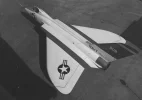
The origins of the Douglas (modified) delta wing F4D reach all the way back to the 1940s. Douglas engineers went to Europe shortly after the end of World War II to investigate advanced German concepts. One intriguing area of interest were the delta wing studies by German aerodynamic engineer Alexander Lippisch. It took some years for the investigation to percolate into actual hardware. Douglas selected the promising Westinghouse J40 afterburning turbojet to power their design. A contract for two prototypes was signed in August 1949. The design, designated XF4D, was intended as an interceptor and had a design internal fuel load of just 640 gallons (4,350 pounds).
First flight of a temporarily J35-powered XF4D-1 came in January 1951 and demonstrated that much work had to be done to make the aircraft into a reasonably stable airplane. A more powerful J40 engine was installed in mid-1952 and Douglas pilots continued to test the Skyray.
In 1953 the Navy got their hands on the XF4D-1 at Patuxent River and in October the aircraft was tested aboard USS Coral Sea. In the same year, the XF4D was used to set world speed records over 3 km and 100 km low-level courses. The 3 km speed was 753 mph and this was the first time that record had been set by a carrier-capable Navy aircraft. The record was short-lived, though, as the USAF's North American YF-100A broke the record again just two months later.
With all that wing area, the F4D was an obvious choice to set time-to-climb records and did so in 1958 in a modified F4D-1 aircraft. As with the low-altitude speed record, the Skyray's records were soon broken by other aircraft.
Although the J40 powered the XF4D's speed record, Westinghouse was in trouble. Their J40 powered the McDonnell F3H-1 Demon and the XA3D-1 Skywarrior. All those aircraft ended up with alternate powerplants and Westinghouse ended up exiting the aircraft engine business. The F4D had the good fortune to adopt the Air Forces's Pratt & Whitney J57 (as did the A3D).
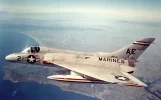
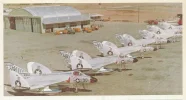
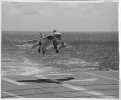
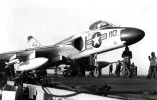
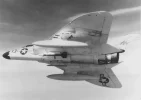
Douglas delivered 419 J57-powered F4D-1s (invariably referred to as "Fords") to the Navy and Marine Corps. In CVGs, one fighter squadron was designated all-weather and was equipped with either F4D-1s or McDonnell F3H-2s. The Marines did not fly the F3H and soon designated their F4D squadrons as VMF(AW)s. As you might expect from a delta-winged aircraft, carrier suitability was always a bit problematic. But the climb rate was terrific. Due to the small fuel load, the F4D-1 (redesignated F-6A) in 1962) almost always flew with two 300-gallon external tanks.
VMF(AW)-115 retired the last operational F-6As in January 1964. The Test Pilot School at Pax flew the F-6A as late as 1969 as an example of what to never do again.
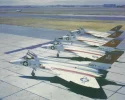
To rewind a bit, Douglas had soon realized that the F4D speed was limited by a thick wing and endurance was limited by the fuel system. The resulting F5D used the same wing planform as the F4D but with a much thinner airfoil. Internal fuel was increased by 54%. The nose was longer and a new radar would be fitted. The first F5D-1 flew in April 1956 and easily exceeded Mach 1 on its first flight. However, the Navy was fully aware that the ongoing F8U-3 and F4H-1 competition would result in an aircraft with much better performance by 1961, and the decision was made to terminate the F5D-1 after only four prototypes had been completed. The F5D weapons system was never installed, and no carrier suitability tests were conducted. The F5Ds were turned over to NACA (soon to be NASA) in 1957-58. NASA retired the F5Ds in 1970.
First flight of a temporarily J35-powered XF4D-1 came in January 1951 and demonstrated that much work had to be done to make the aircraft into a reasonably stable airplane. A more powerful J40 engine was installed in mid-1952 and Douglas pilots continued to test the Skyray.
In 1953 the Navy got their hands on the XF4D-1 at Patuxent River and in October the aircraft was tested aboard USS Coral Sea. In the same year, the XF4D was used to set world speed records over 3 km and 100 km low-level courses. The 3 km speed was 753 mph and this was the first time that record had been set by a carrier-capable Navy aircraft. The record was short-lived, though, as the USAF's North American YF-100A broke the record again just two months later.
With all that wing area, the F4D was an obvious choice to set time-to-climb records and did so in 1958 in a modified F4D-1 aircraft. As with the low-altitude speed record, the Skyray's records were soon broken by other aircraft.
Although the J40 powered the XF4D's speed record, Westinghouse was in trouble. Their J40 powered the McDonnell F3H-1 Demon and the XA3D-1 Skywarrior. All those aircraft ended up with alternate powerplants and Westinghouse ended up exiting the aircraft engine business. The F4D had the good fortune to adopt the Air Forces's Pratt & Whitney J57 (as did the A3D).
Douglas delivered 419 J57-powered F4D-1s (invariably referred to as "Fords") to the Navy and Marine Corps. In CVGs, one fighter squadron was designated all-weather and was equipped with either F4D-1s or McDonnell F3H-2s. The Marines did not fly the F3H and soon designated their F4D squadrons as VMF(AW)s. As you might expect from a delta-winged aircraft, carrier suitability was always a bit problematic. But the climb rate was terrific. Due to the small fuel load, the F4D-1 (redesignated F-6A) in 1962) almost always flew with two 300-gallon external tanks.
VMF(AW)-115 retired the last operational F-6As in January 1964. The Test Pilot School at Pax flew the F-6A as late as 1969 as an example of what to never do again.
To rewind a bit, Douglas had soon realized that the F4D speed was limited by a thick wing and endurance was limited by the fuel system. The resulting F5D used the same wing planform as the F4D but with a much thinner airfoil. Internal fuel was increased by 54%. The nose was longer and a new radar would be fitted. The first F5D-1 flew in April 1956 and easily exceeded Mach 1 on its first flight. However, the Navy was fully aware that the ongoing F8U-3 and F4H-1 competition would result in an aircraft with much better performance by 1961, and the decision was made to terminate the F5D-1 after only four prototypes had been completed. The F5D weapons system was never installed, and no carrier suitability tests were conducted. The F5Ds were turned over to NACA (soon to be NASA) in 1957-58. NASA retired the F5Ds in 1970.