
-
Please take a moment and update your account profile. If you have an updated account profile with basic information on why you are on Air Warriors it will help other people respond to your posts. How do you update your profile you ask?
Go here:
Edit Account Details and Profile
You are using an out of date browser. It may not display this or other websites correctly.
You should upgrade or use an alternative browser.
You should upgrade or use an alternative browser.
Aero Nerdery Thread (rotary-curious welcome)
- Thread starter Gatordev
- Start date

Why not turn on the APU and anti-ice?
This isn't for a -60, so I don't have those. I was using the -60 as an example of why my theory may hold water.
We left one engine in fly and the other at idle for an hour+.
I've done that before as well because I didn't want to risk not being able to start the engine back up. But my question is about burning MORE gas, not conserving gas.
So is your assumption that with one at fly and the other idle, that it’s burning more gas than both at fly? If I’m following you correctly, that doesn’t make sense to me.
This was always a HAC question for us, presumably because I came from a community where we only had a single spot to land on for blue water ops. If you flipped to your blue pages in the PCL, there were single-engine burn rates and max range speeds. The exercise that was taught was that if you're going to single up (in flight) to save gas, actually single up, don't just bring one engine to idle. The fuel burn (according to charts) would be higher with one at idle vs one shut down.
But...
I don't have the data to say if FLY/FLY at min power or FLY/IDLE is less efficient. IDLE is less efficient than FLY, but the FLY engine will be more efficient by itself than it would be sharing the ground load
And this is why I figured I'd ask. I don't have the education to understand the complexities of engine efficiency, let alone the difference at min power vs in flight. I'm just looking at it from a purely anecdotal point of view, watching what my engine instruments do. If both my Tq and TGT/TOTs go up on an engine, it would seem that means it has to burn more fuel than it was before. I totally understand load sharing makes can make it more complicated, I just can't prove how with the limits of my available instrumentation.

Maybe a thought experiment - in the 60 with one in fly and other in idle, look at the torque values. Very vague memory but would say one was around 40% and another low double digits. Compare that number with both engines at fly. Think I remember around 20%.
Sum both, and see how they compare. That might give the answer.
Sum both, and see how they compare. That might give the answer.

Yeah, I remember that HAC question too. Singling up saved gas because at bucket speed the remaining engine doesn’t burn exactly twice the amount of gas as with two motors on.This was always a HAC question for us, presumably because I came from a community where we only had a single spot to land on for blue water ops. If you flipped to your blue pages in the PCL, there were single-engine burn rates and max range speeds. The exercise that was taught was that if you're going to single up (in flight) to save gas, actually single up, don't just bring one engine to idle. The fuel burn (according to charts) would be higher with one at idle vs one shut down.
I may have misinterpreted your question but my point was if you wanted to burn gas it’d likely be better to have both at fly and apu and anti ice on. Well, no apu in your current aircraft.

EC135 still?Well, no apu in your current aircraft.
Correct.EC135 still?
Maybe a thought experiment - in the 60 with one in fly and other in idle, look at the torque values. Very vague memory but would say one was around 40% and another low double digits. Compare that number with both engines at fly. Think I remember around 20%.
I've done this in the -135 (and your -60 numbers sound correct), which is why I'm thinking my theory is correct. Another thing to keep in mind is most civilian helicopters are designed to run at idle, unlike the -60 where the head is fairly unstable at idle.
That said, as far as numbers... with both at idle, you get ~15% Tq each and some TOT (I can't remember off the top of my head). With one in fly, you get ~30% and 0%, with the one in fly having a higher TOT. I need to check to see if TOT stays the same when the other one goes to 0% Tq (+/- a little).
Part of the problem is when I actually need to do this to lose weight, I'm also doing at least 3 other things (setting up a headset for my pax, talking to Ops, diddling with the iPad to set my manifest up correctly, etc) so I can't fully direct my attention to the less than precise fuel gauge and the clock.
Singling up saved gas because at bucket speed the remaining engine doesn’t burn exactly twice the amount of gas as with two motors on.
It also worked at Max Range, which was shown on that chart as well.
Dumb question...does turning the anti-ice on in the -60 on the ground even do anything? The valves are already open and the inlet anti-ice shouldn't turn on if it's warm enough. I can't remember if the TGT goes up on the ground or not...it's been too long.and anti ice on
Either way, no anti-ice on the -135, so no help there.

If ENG ANTI-ICE isn't automatically on when on deck, you've likely got a down Hawk. My comment was for ENG INLET ANTI-ICE, which opens another bleed valve. Now, if the temperature is >13 °C, the bellows won't open, so I'm not sure the extra bleed will cause a significant increase in fuel (evidenced by TGT rise). If was just a thought to maximally squeeze the lemon..Dumb question...does turning the anti-ice on in the -60 on the ground even do anything? The valves are already open and the inlet anti-ice shouldn't turn on if it's warm enough. I can't remember if the TGT goes up on the ground or not...it's been too long.
Either way, no anti-ice on the -135, so no help there.
H135...why didn't you say so? (I think I knew this), but...
I do have data for the UH-72A from my student days at TPS. I'm not posting the whole shebang or getting into the real nerdery of how NATOPS charts are made, but you could get a good guestimate from this chart. The real math is ALT- and OAT-dependent, but this is a spread from 0–17 °C and 0–6500 ft MSL. N1 is what you want to check, TQ is zero. I'd guess you will burn more fuel with one up and one idle, but don't know how much.
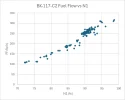
N1 is what you want to check, TQ is zero. I'd guess you will burn more fuel with one up and one idle, but don't know how much.
Nice. I can't remember what N1 is at idle, so I'll have to take a look when I go back to work. Do you know which model or manufacture engine that chart is for? I'm guessing the -145 burns more since it's got more overall power, but looking at that chart and what I think idle N1 is on the -135 Pratts, the amount sounds about in the same ball park.
Thanks for posting that!
Ah, didn't realize the 135 had 'merican engines. 145 has Turbomecca Ariel 1E2 ×2Nice. I can't remember what N1 is at idle, so I'll have to take a look when I go back to work. Do you know which model or manufacture engine that chart is for? I'm guessing the -145 burns more since it's got more overall power, but looking at that chart and what I think idle N1 is on the -135 Pratts, the amount sounds about in the same ball park.
Thanks for posting that!
Far better than the LTS101 of old in the B2 model I flew!Ah, didn't realize the 135 had 'merican engines. 145 has Turbomecca Ariel 1E2 ×2

Pratt & Whitney is Canadian. Just while we're nerding out.Ah, didn't realize the 135 had 'merican engines. 145 has Turbomecca Ariel 1E2 ×2

Give it time...there's a few years of Risk-playing left.Pratt & Whitney is Canadian. Just while we're nerding out.
Give it time...there's a few years of Risk-playing left.
Australia will rule the world.

To be fair, P&W isn’t Canadian. It’s owned by RTX (Raytheon) but has a factory in Canada. Around here it seems like if you don’t work in Boston, you either work for the Navy Yard or for Raytheon/Pratt & Whitney. On the playing Risk side, part of the Canuck/Trump angst over the F-35 (we’re buying, we’re not, well maybe some) is that Raytheon (probably prodded by Defense) said if Canada isn’t buying the F-35 they will happily shift the Canadian works to the U.S.Is there a single American made engine in that SHP class? I do not believe so ...
For some real nerdery, try to figure out just who owns what when something is built at a specific site. Rolls Royce engines are built in Finland while Allison types (now sometimes called LibertyWorks) are still built in the U.S. by Rolls Royce North America. Safran, of France, builds their engines in India and the U.S. Sometimes I get the feeling that if there were ever a WWIII we’d be tossing Brazilian grenades at Finlanders who were fighting on the side of the Mexico Alliance while Australia is conducting air assault operations with American helicopters against Italian bases in Tahiti - or basically humans just fighting to keep the global defense industry profitable.