• Please take a moment and update your account profile. If you have an updated account profile with basic information on why you are on Air Warriors it will help other people respond to your posts. How do you update your profile you ask?

    Go here:

    Edit Account Details and Profile

2026 NIFE Phase 2: Academics

GoBoilers25

Well-Known Member
This post was inspired by @Mouselovr . Their post on academics is still relatively in date but there are enough differences now that I believe a new details post was warranted. Their post on NIFE academics is linked here: nife-phase-2-academics-details-2023.49505

Schedule: NIFE 2 is still 5 courses in 3 weeks: Aero, Engines, Flight Rules and Regulations, Navigation, and Weather. The content is a firehose of information, and I cannot emphasize the importance of studying ahead once you check into Pensacola. You’ll learn Aero and Engines in week 1, FR&R and Navigation in week 2, and Weather in Week 3. You’ll take the Aero exam in week 1, Engines and FR&R in week 2, and Nav/Weather in week 3. Get the gouge,

Usually you’ll begin somewhere between 0800-0900 and go until around 1400-1500. Some days are shorter, some are longer, particularly for NAV. You’ll have a designated time to workout during certain days of the week, but usually as long you get your workout in at some time during that day, you don’t necessarily have to go at the listed time.

Failing exams: This is the biggest difference. Previously, it was:

1st Failure: Review exam, retake the next day.
2nd Failure: Go before a board, explain why you failed, roll back one week to get more time to study.
3rd Failure: Almost always attrition outside of human factors reasons.

Now the process goes:

1st Failure: Review exam; retake exam the next day.
2nd Failure: Almost always attrition outside of human factors reasons.

This means that you can, for example, fail engines, retake it the next day, fail it again, and get attrited all within a 24 hour period. Again, as previously stated, the importance of studying before academics begin cannot be understated. Failing an exam also puts you behind a full day on other courses in a phase that only lasts 19 days. Do not fall behind.

Passing: The passing scores remain unchanged. 80% is passing for an exam but your NIFE average must be at least 86% over the 5 exams. If your average is between 80%-86% you’ll go before a board who will decide if you stay. If you fail one exam and pass the retake, your original lower score is used to calculate your average.

The 2 failure policy also carries over to flight stage. You could fail Aero, pass the next 13 exams/flight events, fail your check ride, and that is your 2nd failure.

After the Weather exam you move onto one week of ground school. This is a relatively light week compared to the 3 previous so it is a great time to get ahead on your cockpit trainers.

When you get to Pensacola, there will be a QR code you can scan to access a folder with all of the information you will need for academics. Please utilize this. If you study ahead, it will make NIFE significantly less stressful and more enjoyable. NIFE is only a sneak peek on the grind that you’ll go through in Primary, and getting ahead here will set you up for success.
 
Great write up and thanks for updating the gouge.
Glad to be an inspiration haha.

I’m disappointed to hear they’ve upped attrition to only the 2nd exam fail. It will wipe ~15% of every class just with NAV.

What rate are people failing flight phase events? It was incredibly common during my time….. to the point where if you went to a board in VTs/HTs, they’d ignore those pink sheets.

Is this upped attrition bar for all 3 service branches?

What’s entailed in the ground school? Ours was only 2 days.

When people have an 80-86%, are they typically being retained? When I went through, it was just a stern meeting with the CO.
 
Great write up and thanks for updating the gouge.
Glad to be an inspiration haha.

I’m disappointed to hear they’ve upped attrition to only the 2nd exam fail. It will wipe ~15% of every class just with NAV.

What rate are people failing flight phase events? It was incredibly common during my time….. to the point where if you went to a board in VTs/HTs, they’d ignore those pink sheets.

Is this upped attrition bar for all 3 service branches?

What’s entailed in the ground school? Ours was only 2 days.

When people have an 80-86%, are they typically being retained? When I went through, it was just a stern meeting with the CO.
Should have included that this only applies to Navy. Marines are still at 3 pink sheets and if I'm not mistaken the Coast Guard is too. Its definitely claimed more than a few people already but I think the idea behind it is if you pick up 2 failures in NIFE then your odds of successfully completing the program are relatively low compared to someone with zero or one failure. It does seem tough but it's likely intended to attrite people early vice letting them get halfway through primary and then fail out. I'm sure they have the numbers to back up their decision, i.e., what % of people with one failure and two failures make it through the program.

Ground school is its own week with three days of classes with the ground school exam on Thursday of week 4. It includes a multiple choice section and an EP's and Limits quiz that needs to be verbatim. The multiple choice section is 80% to pass.
 
Great write up and thanks for updating the gouge.
Glad to be an inspiration haha.

I’m disappointed to hear they’ve upped attrition to only the 2nd exam fail. It will wipe ~15% of every class just with NAV.

What rate are people failing flight phase events? It was incredibly common during my time….. to the point where if you went to a board in VTs/HTs, they’d ignore those pink sheets.

Is this upped attrition bar for all 3 service branches?

What’s entailed in the ground school? Ours was only 2 days.

When people have an 80-86%, are they typically being retained? When I went through, it was just a stern meeting with the CO.
I'm not entirely sure about the people who fell between 80%-86%. I've heard its mostly a "Hey man, lets clean this up before you screw it up in primary" but I wouldn't be shocked if it was more strict now. Flight failures are less common but they do happen. Those pink sheets have been treated the exact same as academic pink sheets in NIFE.
 
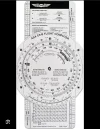
SUPER random question. Do they make you use the standard whiz wheel during nav? Or are u good to use an electronic E6B. (I absolutely hate this thing 😂)IMG_2813.jpeg
 
Do you guys still get the issued the CR-2? @Jowen872 the CR-2 is a little easier to use than the E6B. That said, knowing the fundamentals is good before you move (back) to the pink line.


Why do we do this to ourselves? I blame annoying helicopter dudes and pretty much all of VP.
That’s good. Mostly I was just worried about the fact that I make some small mistakes with the E6B. I just spent about an hour re-learning it and trying to prep a nav log purely using the E6B. Went fine but the numbers can seem a little imprecise at times which just bugs me. Obviously you’ll be using it for exams but is it expected to be used in practice during primary and beyond? I would imagine it’s sort of a mixed answer where you don’t necessarily have to make your logs with it but if you get checked on your proficiency using it you’re definitely gonna want to know how haha.
 
but I think the idea behind it is if you pick up 2 failures in NIFE then your odds of successfully completing the program are relatively low compared to someone with zero or one failure.
I'd heard the same narrative of NIFE performance = odds of program completion/success.

If you dig in the public CNATRA folder, you can find the yearly attrition rates (to include DOR/med) out of each stage of training (NIFE/VT/Advance/FRS). VTs are absolutely the highest on paper.

I get the logic of "upping" the NIFE bar as the easy solution, but to anyone who's completed a flight school syllabus, we know that
NIFE success =/= VTs success and onward. I'm sure there's math to back up their decision, but I watched about a dozen people attrite throughout the pipeline and another dozen DOR, most were in the early phases of the VTs. Many low-performance NIFE studs went on to be the top of their class in a flight syllabus. The reverse was also true of high NIFE NSS students finishing at the bottom/failing to attrition.

Point is, NIFE is a sprint up a cliffside they've just made steeper. Primary and onward is a sloped mountain requiring endurance. If you're someone about to start/just finished NIFE, don't take your prior performance as an under/over-confidence in your ability to succeed moving forward.
Marines are still at 3 pink sheets
Is BLADE still a thing (the NIFE prep course for the MC)? The marines used to have their own weird system where you could pass all of NIFE but be cut due to prior BLADE grades. It was literally a double-edged sword/ BLADE :)
It says that it needs to be “verbatim”, but if the student uses a word that the instructor views to hold the same meaning then it is satisfactory. There’s obviously some ambiguity with that so the safest thing for us was to just have it verbatim.
In my class, our instructor said he'd fail anyone who didnt get it "verbatim-verbatim" except for the one Italian dude. He was allowed to misspell some words haha.
be used in practice during primary and beyond?
No ha. Unless the syllabus has changed, there's a day in instrument ground school in Primary where you'll relearn how to calculate d=st for about 10 minutes, then get asked 1-2 Qs about it on a test. To my relief, I haven't seen one since.
 
I'd heard the same narrative of NIFE performance = odds of program completion/success.

If you dig in the public CNATRA folder, you can find the yearly attrition rates (to include DOR/med) out of each stage of training (NIFE/VT/Advance/FRS). VTs are absolutely the highest on paper.

I get the logic of "upping" the NIFE bar as the easy solution, but to anyone who's completed a flight school syllabus, we know that
NIFE success =/= VTs success and onward. I'm sure there's math to back up their decision, but I watched about a dozen people attrite throughout the pipeline and another dozen DOR, most were in the early phases of the VTs. Many low-performance NIFE studs went on to be the top of their class in a flight syllabus. The reverse was also true of high NIFE NSS students finishing at the bottom/failing to attrition.

Point is, NIFE is a sprint up a cliffside they've just made steeper. Primary and onward is a sloped mountain requiring endurance. If you're someone about to start/just finished NIFE, don't take your prior performance as an under/over-confidence in your ability to succeed moving forward.

Is BLADE still a thing? The marines used to have their own weird system where you could pass all of NIFE and still be cut bc of BLADE grades.
It was a double edged sword that used to prep them for NIFE but could also hurt them.

In my class, our instructor said he'd fail anyone who did get it "verbatim-verbatim" except for the one Italian dude. He was allowed to misspell some words haha.

No ha. Unless the syllabus has changed, there's a day in instrument ground school in Primary where you'll relearn how to calculate d=st for about 10 minutes, then get asked 1-2 Qs about it on a test. I haven't seen one since.
Overall, just out of curiosity, how big of an advantage is it to have a good amount of experience (particularly in instrument flying/ground school) prior to going to Pcola? I’m going into it with the understanding that you’re gonna learn everything again, in a lot of cases differently. I’m just wondering if it’s going to help reduce your workload if you have a good amount of familiarity with the subject matter? Because what I gather is that most of NIFE/API is a super condensed ground school course with some intro flying and it has the tendency to be information overload.
 
Overall, just out of curiosity, how big of an advantage is it to have a good amount of experience (particularly in instrument flying/ground school) prior to going to Pcola?
Its just NIFE now. API is what the program used to be called.

They've likely updated the tests since I was in NIFE, so a more recent grad can probs chime in with better accuracy.

But overall, yes. Even if you try to pre-study NIFE, most people are learning the information for the first time and have never flown. IMO, the goal of NIFE is less to teach people the basics of flying, but to stress test people to make them ask:

1. Can I do this?
2. Do I want to continue doing this?
3. If no to either of these, I probably should DOR

You've got a baseline working knowledge that will help you work through the "aviation common sense" multiple choice that folks with 0 flight time cannot. From what I saw, most people with prior aviation exp did very well in NIFE and onward bc they actively built on their prior knowledge. Where prior experience can be a detriment is when folks are too set in their ways, and the Navy wants you to learn/brief/fly their way.
 
IMO, the goal of NIFE is less to teach people the basics of flying, but to stress test people to make them ask:

1. Can I do this?
2. Do I want to continue doing this?
3. If no to either of these, I probably should DOR
This was another thing I was wondering about because when I looked at the stats, a very significant amount of the early attrition was DORs. That led me to wonder if it was purely voluntary or if the DOR was requested to make things less complicated.
 
Back
Top