• Please take a moment and update your account profile. If you have an updated account profile with basic information on why you are on Air Warriors it will help other people respond to your posts. How do you update your profile you ask?

    Go here:

    Edit Account Details and Profile

Road to 350: What Does the US Navy Do Anyway?

Case law plz.
US v Rockwood (1996)
US v Bergdahl (2017)
US v Mason (2004)
All of the Tailhook cases

NJP isn't legal proceedings.
Yeah I know. I was pointing out that the decision to use NJP is discretionary by the government for expediency sake. If they chose to they could adjudicate everything under the UCMJ (because the service member took the oath that enables them to do that).

Is it your contention that a refusal to obey lawful orders in that situation wasn't "serious?"
It's my contention that it wasn't serious enough in the courts martial convening authority's opinion. I don't have an opinion beyond that.

I get that makes you mad but most sailors aren't lifers and have no emotional attachment to service.
OK...why would that make me mad? I'm not being prescriptive. Just descriptive. It's just a fact that service members are held accountable to the UCMJ because they took the oath. That's all.
 
New CMSI report from the Naval War College on the changes happening with PLA Naval Aviation training and career paths over the last 2 decades. Looks like the PLAN can’t escape a pipeline bottleneck either.

A couple of interesting things I saw in there...

1) They seem to be adopting a more RAG-like training program where they push some operational training to an early school instead of doing it all in the fleet unit. Something a USN fleet squadron is always asking more of. But...

Despite these improvements, pilots still undergo a certain amount of training at operational units prior to attaining combat qualification.

They're still doing the flying at fleet units. Queue the annual fleet CO surveys regarding RAG quality output.

2) This:

Helicopter training exercises are incorporating what the PLA refers to as “hot pitting” (refueling and rearming while an aircraft is running).66 Coverage of helicopter training focuses on how pilots are required to plan their own flight routes and must fly under a variety of conditions, including dangerous weather conditions.

I'm assuming the previous model was based on a more Communist model where you don't need to think when mission planning, lest you start thinking independently. It's interesting how the basic function of doing one's own flight planning is a novel approach.

I'm also curious what "dangerous weather conditions" actually means. I wonder if there is something lost in the translation and they just mean night/IMC.
 
A couple of interesting things I saw in there...

1) They seem to be adopting a more RAG-like training program where they push some operational training to an early school instead of doing it all in the fleet unit. Something a USN fleet squadron is always asking more of. But...

They're still doing the flying at fleet units. Queue the annual fleet CO surveys regarding RAG quality output.

I'm pretty sure that the Chinese inherited the 'regimental' method of training aviators from the Russians, where folks get their wings then go directly to their operational regiment where they train on their fleet aircraft and become a qualified operational pilots without a RAG equivalent anywhere in the pipeline. This made for uneven training throughout the two Soviet air forces, with some regiments having a good rep while others did not. Since PLAN naval aviation is still small I would guess they are still doing some form of the regimental system without a RAG in the mix yet, and the operational training still occurring at the Navy regiments or equivalents.

Another thing to note is they still seem stuck on the lengthy ground instruction that the Russians also do, with dedicated aviation schools that take 3-4 years to go from start to finish getting your wings and degree when you graduate. I am not sure if the university grads have to go through the training as well but I think our qualifications of a degree and passing some tests have worked really well for us, interesting that others like Russia and possibly China still stick to a much more rigid system, which at least for the Russians doesn't seem to pay any dividends.

Great stuff, thanks for posting the link.
 
11 month deployments the norm? 😭

What other 2nd and 3rd order effects do you think will happen when US forces are use in a “war”?

Logistic? Money? Aircraft FLE? Ordnance? Ship Maintenance?
1793768883370.webp
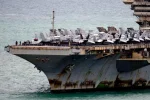
(USS Abraham Lincoln returning from extended deployment)
Are we winning yet? Trump thinks so.
“We had a war with Iran. We won," Trump said.

"I don't even know if you call it a war because we haven't been doing any fighting for months, you know?" he added. "We control the Strait of Hormuz. We control it and strongly control it."
 
Another thing to note is they still seem stuck on the lengthy ground instruction that the Russians also do, with dedicated aviation schools that take 3-4 years to go from start to finish getting your wings and degree when you graduate.

I took that document to be explaining that the primary accession source was some sort of university-type program and then to flight school. I could have missed understood, but it seemed like it was saying a VOTEC-like approach direct from high school was the norm.

That's not meant to argue your point, but I don't know that it's that different (from a 10,000 foot view) from our ROTC/USNA model, albeit I sense our programs have a more liberal arts approach in addition to any technical degree, versus their more vocational approach.

The Soviet training program was a university/college program where they went through flight school at the same time, then getting their degrees and wings at the same time when they graduated. The schools were very technical based and obviously concentrated on flying subjects, with party education and others thrown in for good measure. I presume, and I do admit it is a big presumption, the the 'aviation universities' mentioned in the report are a similar setup since much of their system is based on the Soviet one.

They also do point out they've expanded who they recruit but then don't say what their training path is. Is it an ROTC or OCS style program or a even a Sandhurst-style one, when most cadets (both university grads and not) go to a full year of officer training. It does sound like you say that they even have a direct to flight school model, like the Israelis who don't need to go to college/university to go to flight school.

So while a decent report it does have its shortcomings and I have a lot of questions about their program/s after reading it. They certainly could have used someone with an aviation background to help co-author it, a recurring issue I see elsewhere.
 
Back
Top