

-
Please take a moment and update your account profile. If you have an updated account profile with basic information on why you are on Air Warriors it will help other people respond to your posts. How do you update your profile you ask?
Go here:
Edit Account Details and Profile
You are using an out of date browser. It may not display this or other websites correctly.
You should upgrade or use an alternative browser.
You should upgrade or use an alternative browser.
Ship Photo of the Day
- Thread starter Randy Daytona
- Start date

One of the most decorated ships of WW2 was USS San Diego CL-53, an Atlanta class light cruiser optimized for anti-aircraft defense. Not having the traditional 6” guns of light cruisers, instead she had 16 (8x2) dual 5”/38’s and was able to put up a larger broadside fleet defense barrage than any battleship. She was also the first ship to enter Tokyo Bay after the surrender of Japan.
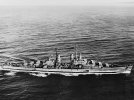
USS San Diego, 8 March 1944
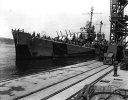 San Diego arrives at Yokosuka Naval Base, 30 August 1945
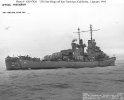
USS San Diego (CL 53) Off San Francisco, California, 1 January 1944.
U.S. Naval Historical Center Photograph
USS San Diego, 8 March 1944
San Diego arrives at Yokosuka Naval Base, 30 August 1945USS San Diego (CL 53) Off San Francisco, California, 1 January 1944.
U.S. Naval Historical Center Photograph
USS Monadnock BM-3 was a large Amphitrite class monitor, notable for crossing the Pacific to fight in the Spanish American War. Evidently, one crossing in this ship was enough as it never returned to the US, staying on station in China and the Philippines until the end of her career.
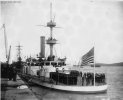
Monadnock (BM-3) is seen off Mare Island Navy Yard, CA, June 1898, ready for her voyage to the Philippines.
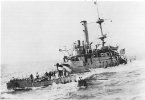
At sea between San Francisco, CA, and Manila, Philippine Islands, circa June-August 1898. Photographed from Nero(1898-1922), her escort on the trans-Pacific voyage.
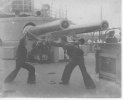
Hand to hand practice with swords in front of the main 2 dual 10" turret of the Monadnock (BM-3), circa 1900 - 1904.
After 22 years of construction the Monadnock (BM-3) is commissioned at Mare Island Navy Yard on 20 February 1896.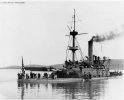 |
At sea between San Francisco, CA, and Manila, Philippine Islands, circa June-August 1898. Photographed from Nero(1898-1922), her escort on the trans-Pacific voyage.
Hand to hand practice with swords in front of the main 2 dual 10" turret of the Monadnock (BM-3), circa 1900 - 1904.

HMS Ark Royal Pennant 91 was the first British carrier built with the hangars and flight deck integrated as part of the ship. It participated in numerous engagements early in WW2, most prominently the battle with Bismarck.
Ark Royal was sunk in November 1941 by a single torpedo from U-81 after which the Captain was court marshalled. However, lessons were learned to add both compartmentalization and diesel generators which would serve well later classes of Royal Navy carriers.
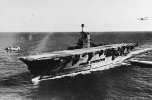
HMS Ark Royal in 1939, conducting flying operations with Swordfishbiplanes
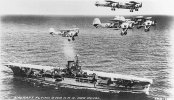
HMS Ark Royal in 1939, with Swordfish of 820 Naval Air Squadron passing overhead
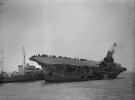
Ark Royal was sunk in November 1941 by a single torpedo from U-81 after which the Captain was court marshalled. However, lessons were learned to add both compartmentalization and diesel generators which would serve well later classes of Royal Navy carriers.
HMS Ark Royal in 1939, conducting flying operations with Swordfishbiplanes
HMS Ark Royal in 1939, with Swordfish of 820 Naval Air Squadron passing overhead
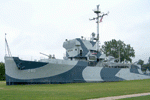
USS Hazard AM-240 was 1 of the 123 Admiral class minesweepers built during WW2. In addition to minesweeping, she was also capable of anti-submarine, patrol and convoy escort duties. The only surviving member of her class, she is now a museum in Omaha, Nebraska.
Interesting that these ships were steel hulled, but the follow-on classes were wooden hulled.
Length: 184’, beam: 33’, draft: 530 tons
2 diesels of 1,700 hp each gave 15 knots
Armament: 1 3”/50 cal cannon, 4 (2x2) Bofors 40mm, 6 single Oerkilon 20 mm, 2 depth charge tracks.
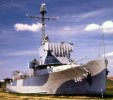
USS Hazard at Freedom Park in Omaha, Nebraska
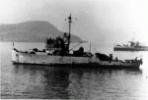
August 1945
Buckner Bay, Okinawa
Interesting that these ships were steel hulled, but the follow-on classes were wooden hulled.
Length: 184’, beam: 33’, draft: 530 tons
2 diesels of 1,700 hp each gave 15 knots
Armament: 1 3”/50 cal cannon, 4 (2x2) Bofors 40mm, 6 single Oerkilon 20 mm, 2 depth charge tracks.
USS Hazard at Freedom Park in Omaha, Nebraska
August 1945
Buckner Bay, Okinawa

With events in the Persian Gulf, a look back at the fleet oilers of WW2, in particular the Cimarron class of 35 high speed tankers. Often commanded by flight status Navy captains getting their prerequisite deep draft command before commanding an aircraft carrier, the ships were heavily armed. Normal armament consisted of 4 5”/38 cal dual purpose, 8 (4x2) 40mm Bofors, and 8 (4x2) 20 mm Oerlikons on a platform of 553 ft and displacement of 25,000 tons. Only 2 were sunk during the entire war. Somehow, I don’t think they would be overly concerned about a Shahed…
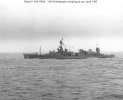
USS Cimarron (AO-22) refueling USS Northampton (CA-26) during the Doolittle Raid mission. Photographed from USS Salt Lake City (CA-25). The original photo caption states that this view was taken on 18 April 1942, the day the Doolittle Raid aircraft were launched to attack targets in Japan.
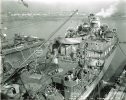
Aft plan view of USS Cimarron (AO-22) at Mare Island Navy Yard, 26 November 1942.
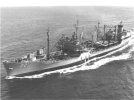
USS Cimarron (AO-22) underway, 4 May 1955, location unknown.
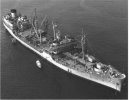
USS Cimarron (AO-22) underway, June 1959, location unknown.
USS Cimarron (AO-22) refueling USS Northampton (CA-26) during the Doolittle Raid mission. Photographed from USS Salt Lake City (CA-25). The original photo caption states that this view was taken on 18 April 1942, the day the Doolittle Raid aircraft were launched to attack targets in Japan.
Aft plan view of USS Cimarron (AO-22) at Mare Island Navy Yard, 26 November 1942.
USS Cimarron (AO-22) underway, 4 May 1955, location unknown.
USS Cimarron (AO-22) underway, June 1959, location unknown.

40mm ammunition won’t keep Raytheon stock up.With events in the Persian Gulf, a look back at the fleet oilers of WW2, in particular the Cimarron class of 35 high speed tankers. Often commanded by flight status Navy captains getting their prerequisite deep draft command before commanding an aircraft carrier, the ships were heavily armed. Normal armament consisted of 4 5”/38 cal dual purpose, 8 (4x2) 40mm Bofors, and 8 (4x2) 20 mm Oerlikons on a platform of 553 ft and displacement of 25,000 tons. Only 2 were sunk during the entire war. Somehow, I don’t think they would be overly concerned about a Shahed…
View attachment 44743
USS Cimarron (AO-22) refueling USS Northampton (CA-26) during the Doolittle Raid mission. Photographed from USS Salt Lake City (CA-25). The original photo caption states that this view was taken on 18 April 1942, the day the Doolittle Raid aircraft were launched to attack targets in Japan.
View attachment 44744
Aft plan view of USS Cimarron (AO-22) at Mare Island Navy Yard, 26 November 1942.
View attachment 44745
USS Cimarron (AO-22) underway, 4 May 1955, location unknown.
View attachment 44746
USS Cimarron (AO-22) underway, June 1959, location unknown.
Ryan Szymanski was on Battleship New Jersey discussing how the 1945 version of the ship was better protected against drones than the last version. A few photos showing of ships showing their AA suites:
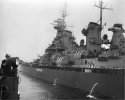
Sailors line the deck of Missouri (BB-63) as Renshaw (DD-499) comes alongside for transfer of President Harry S. Truman during Navy Day celebrations in New York.
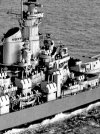
This U.S. Navy photo, taken 12 November 1943 of USS Iowa by a Navy blimp, was discovered by author L. Douglas Keeney while researching an upcoming book.
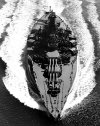
May 1943 photo of the Tennessee (BB-43) as rebuilt and on post refit trials. Not a flattering shot for a lady with a wide beam, but it readily shows the "new" hull design that was also applied to the California (BB-44) and West Virginia (BB-48).
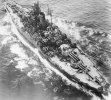
Photo taken in 1944 showing the crowded condition of USS Mississippi with the extra 40mm and 20mm guns. They were added wherever deck space was available.
Sailors line the deck of Missouri (BB-63) as Renshaw (DD-499) comes alongside for transfer of President Harry S. Truman during Navy Day celebrations in New York.
This U.S. Navy photo, taken 12 November 1943 of USS Iowa by a Navy blimp, was discovered by author L. Douglas Keeney while researching an upcoming book.
May 1943 photo of the Tennessee (BB-43) as rebuilt and on post refit trials. Not a flattering shot for a lady with a wide beam, but it readily shows the "new" hull design that was also applied to the California (BB-44) and West Virginia (BB-48).
Photo taken in 1944 showing the crowded condition of USS Mississippi with the extra 40mm and 20mm guns. They were added wherever deck space was available.
A few photos of USS Idaho BB-42, a New Mexico class Standard battleship. Like most of the older battleships, she was rebuilt with a much heavier AA armament. The 1942 refit included 10 quadruple 40 mm Bofors + 43 20mm Oerkilons. Uniquely, she was refitted with 10 (not 20) 5”/38 dual purpose cannons using the single gun turret from the Fletcher class destroyers, not the twin turret from the Sumner class.
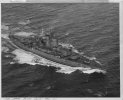
Idaho's (BB-42) forward main turret is trained to starboard during battle exercises when she entered Puget Sound Navy Yard to be re-gunned. Upon completion of this work Idaho again took part in battle exercises, and sailed 7 April 1943 for operations in the bleak Aleutians.
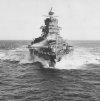
Next on the Pacific timetable was the invasion of the Marshalls, and the veteran battleship arrived off Kwajalein early 31 January 1944 to soften up shore positions. Again she hurled tons of shells into Japanese positions until 5 February, when the outcome was one of certain victory.
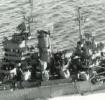
Close up views of port side showing the 5"/38 caliber single enclosed mounts added to the Idaho (BB-42) at Puget Sound Naval Shipyard in late 1944
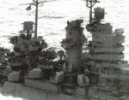
January 1945 in Puget Sound after her last major overhaul at Bremerton Navy Yard that began 22 October 1944.
In addition to the ten 5/38 single enclosed secondary battery Idaho (BB-42) also had upgrades to fire control equipment. This included Mk 8 Mod 2 main battery fire control radar mounted in front of her forward Mk 31 main battery director. She still retained her aft Mk 3 main battery fire control radar mounted on the aft Mk 31 director. A Mk 27 main battery director was mounted on the Conning Tower.
For secondary battery control Idaho had MK 28 radars installed on her two Mk 33 directors. She also had fourteen MK 51 directors for her 40mm guns.
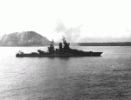
Bombarding Iwo Jima, circa late February 1945.
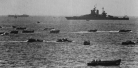
Sitting among circling landing craft, the Idaho (BB-42) takes up her assigned bombardment station, off Okinawa as the invasion begins. The Idaho was flagship of Bombardment Unit 4 and had been hitting Japanese shore batteries and installations for almost a month before this 1 April 1945 photo.
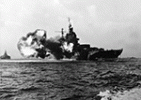
Idaho (BB-42) & West Virginia (BB-48) provide fire support during the invasion of Okinawa.
Idaho's (BB-42) forward main turret is trained to starboard during battle exercises when she entered Puget Sound Navy Yard to be re-gunned. Upon completion of this work Idaho again took part in battle exercises, and sailed 7 April 1943 for operations in the bleak Aleutians.
Next on the Pacific timetable was the invasion of the Marshalls, and the veteran battleship arrived off Kwajalein early 31 January 1944 to soften up shore positions. Again she hurled tons of shells into Japanese positions until 5 February, when the outcome was one of certain victory.
Close up views of port side showing the 5"/38 caliber single enclosed mounts added to the Idaho (BB-42) at Puget Sound Naval Shipyard in late 1944
January 1945 in Puget Sound after her last major overhaul at Bremerton Navy Yard that began 22 October 1944.
In addition to the ten 5/38 single enclosed secondary battery Idaho (BB-42) also had upgrades to fire control equipment. This included Mk 8 Mod 2 main battery fire control radar mounted in front of her forward Mk 31 main battery director. She still retained her aft Mk 3 main battery fire control radar mounted on the aft Mk 31 director. A Mk 27 main battery director was mounted on the Conning Tower.
For secondary battery control Idaho had MK 28 radars installed on her two Mk 33 directors. She also had fourteen MK 51 directors for her 40mm guns.
Bombarding Iwo Jima, circa late February 1945.
Sitting among circling landing craft, the Idaho (BB-42) takes up her assigned bombardment station, off Okinawa as the invasion begins. The Idaho was flagship of Bombardment Unit 4 and had been hitting Japanese shore batteries and installations for almost a month before this 1 April 1945 photo.
Idaho (BB-42) & West Virginia (BB-48) provide fire support during the invasion of Okinawa.